Why Choose a Montessori Learning Center Fremont for Early Childhood Education?
The right early learning environment shouldn’t feel exactly the same from one year to the next. As children grow, they need new challenges, different kinds of support, and more opportunities to use what they’ve already learned.
This matters for families exploring a Montessori preschool Fremont. Rather than treating early learning as one fixed experience, Montessori provides a progression that responds to where children actually are in their development, and where they’re ready to go next.
What Changes as Children Move Through Early Childhood?
Early childhood includes a number of stages, and the needs of children vary greatly from one to another during these years.
The younger child will require assistance in terms of routine activities, communication skills, and transitions; however, as the child becomes older, the need for advanced activities and concentration on tasks increases. The social aspect of the child also undergoes transformation.
An early learning environment needs to leave room for those changes rather than expecting every child to follow the same path at the same pace.
How Can a Montessori Environment Grow With the Child?
One thing parents think about when comparing early learning options is whether the environment can provide appropriate experiences as their child develops, not just right now.
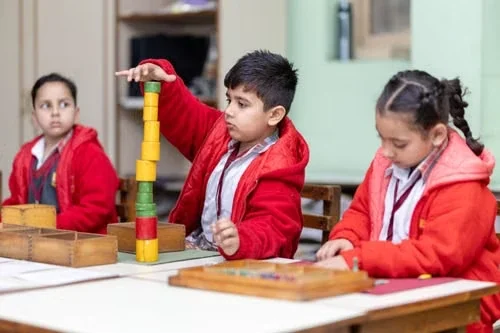
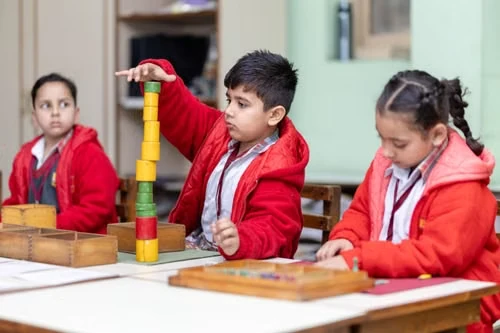
In the Montessori system, tasks and expectations increase with time. A young child may start off by simply exploring and doing what he already knows how to do. He later works with materials that require him to focus, coordinate, and even solve problems.
The teacher’s responsibilities change along with those of the child. The child may need more demonstration and guidance at first. As abilities develop, teachers offer prompts, introduce new challenges, and give the child more room to work things through independently.
The environment stays familiar. The child’s experience within it keeps developing.
What Does Progression Look Like Across Montessori Early Learning?
Progression doesn’t mean every child hits the same milestone at the same time. It means learning experiences become appropriate to a child’s changing abilities.
| Stage | How the Learning Experience Can Change |
| Younger children | Familiar routines, sensory experiences, movement, early communication |
| Early preschool | More choices, practical activities, language experiences, guided exploration |
| Preschool age | Longer activities, problem-solving, collaboration, more complex materials |
This makes it easier for children to progress without their early learning experience being totally transformed.
Why Does Consistency Matter When Children Move Between Early Learning Stages?
Young children get comfortable with familiar people, spaces, and routines. Some continuity makes changes feel less overwhelming as needs develop.
A child who already understands how the classroom works doesn’t have to figure out an entirely new environment at the same time as adjusting to new expectations. That’s a meaningful difference.
Consistency also helps teachers. They can build on what a child already knows rather than starting from scratch each time a new stage begins.
Gradual change is healthy. Children can become comfortable with new expectations while still having something familiar to stand on.
How Can Montessori Teachers Adjust Their Support as Children Develop?
Teachers’ intervention should not be the same throughout the early childhood years.
In the case of young children, teachers need to devote more time to demonstration, assistance, and comfort. When children grow and become more independent, teachers move to observation and guidance, which includes the introduction of new objects, questioning, and giving children space to resolve problems on their own.
This balance is very important. Help is provided, but children also get an opportunity to solve their problems on their own.
At Sparkle Montessori, teachers help children with the use of observation and appropriate age guidance as their abilities and interests change.
How Does Montessori Daycare Fremont Connect With Preschool Learning?
For younger children, daycare is an important starting point, becoming comfortable in a group environment, learning routines, exploring movement, and early social interaction. A Montessori Daycare Fremont can lay those foundations before preschool-level experiences begin.
When those early experiences connect rather than feel completely separate, children don’t have to start from scratch. A child already comfortable with classroom routines finds it easier when activities become more involved. Familiar teachers and peers provide continuity during developmental transitions.
Early care and preschool learning don’t have to feel disconnected, and in a well-designed Montessori program, they won’t.
What Should Parents Consider When Comparing Montessori Schools in Fremont?
Programs can use similar language while offering very different experiences. When comparing Montessori Learning Center Fremont, looking at how a program approaches progression gives more useful information than checking whether Montessori materials are present.
Worth asking:
- How does the program support different age groups?
- How are children introduced to more challenging activities?
- How does teacher support change as children develop?
- How are transitions between stages handled?
- How do teachers communicate progress with parents?
A visit helps too. Watching the classroom in practice- whether children seem comfortable, whether teachers are attentive, whether activities feel appropriate- tells you more than a program description ever will.
What Does Montessori Learning Fremont Look Like as Children Become More Capable?
Montessori Learning Fremont is better understood as a gradual process than a single type of activity. Children move from exploring something for the first time, to practicing it, to using it independently, to applying it somewhere new.
The level of challenge changes with the child. Learning doesn’t become more complicated for its own sake; it becomes more meaningful as children become ready for new experiences.
How Can Families Know if This Approach Fits Their Child?
No single environment suits every child in exactly the same way.
Think about your child’s temperament, comfort with routines, response to new challenges, and need for social interaction. Consider whether you want an environment that can support your child across different early childhood stages rather than just the current one.
A school visit usually answers more questions than anything else. Watching the classroom and speaking with teachers gives a much clearer image than relying on a description alone.
How Can a Montessori Environment Support a Child’s Early Learning Journey?
It is a common assumption that all stages are the same, but the early learning experience at Sparkle Montessori is tailored to meet different needs.
Routines that are familiar create consistency. New age-appropriate activities present challenges. As children become more comfortable, so does the teacher’s guidance.
The true value for parents is not just being in the same environment for a longer time but being in an environment that continues to offer experiences.
Why Can Continuity Matter in Early Childhood Education?
Choosing a Montessori program isn’t only about what a child experiences at enrollment. It’s worth thinking about how the environment will respond as the child grows.
Children can progress further in an environment that appropriately adapts the activities, expectations, and teaching support without each stage starting from scratch.
For families considering a Montessori preschool Fremont, that sense of progression can be one of the most important parts of the decision.
FAQs
- Can a Montessori program support children at different early childhood stages?
Yes, activities and teacher support adjust as children develop new abilities.
- How does Montessori learning change as a child gets older?
The activities become more and more complex, and the children have more opportunities to use their knowledge and face new challenges.
- What should parents ask about transitions between Montessori age groups?
How children move from one stage to another, how progress is communicated, and how activities change as developmental needs change.
- Can Montessori daycare and preschool be part of the same early learning journey?
Yes. When routines and approaches are shared between settings, children have an easier transition from early care to preschool.
- Does Montessori suit children who develop at different rates?
It can- through observation, age-appropriate activities, and adjusted guidance. Parents should still evaluate whether the specific program fits their child.