
Montessori Fremont Programs That Inspire Independent Learning
The word “independent” gets mentioned a lot when people talk about Montessori. But what does that actually look like for a two, three, or four-year-old?
It’s usually not what people expect. Independence at this age doesn’t show up in big moments- it shows up in small ones. A child who puts their materials back without being asked, one who pours their own water at snack time, or one who tries something again instead of waiting for help.
These things seem minor, but they’re exactly where independence starts. That’s why families exploring Montessori Fremont programs tend to pay less attention to the curriculum and more to how children actually move through their day, because those everyday moments are where the real development happens.
Why do Montessori programs look different at every age?
Because children at different ages are genuinely different, not just in what they know, but in what they’re ready for.
A toddler and a preschooler have different needs, different attention spans, and different things they’re working on developmentally. It wouldn’t make sense to run the same classroom for both.
Montessori programs are built around that reality. Activities are introduced when children are actually ready for them, not because everyone in the room has reached a certain birthday.
This means children can build skills step by step, at a pace that actually fits where they are.
How does independence begin during the toddler years?
Usually with something very small.
The toddler years are the first real opportunity to shift children from watching adults do things to doing things themselves. Families looking at Montessori for toddlers in Fremont often notice that the emphasis isn’t on more work- it’s on more ownership.
That might look like:
- Choosing an activity independently
- Returning learning materials after use
- Washing hands before meals
- Pouring water into a cup
- Helping tidy up the classroom
None of these tasks are impressive in isolation. But taken together, over weeks and months, they build something real: coordination, a sense of responsibility, and the quiet confidence that comes from doing things yourself. Children who have that start approaching new experiences differently. They try instead of waiting.
How does a Montessori journey change as children grow?
Gradually, rather than suddenly.
With the development of skills in the child, the environment changes to accommodate for this change. Tasks become more difficult, the child is assigned more responsibility, and they are expected to think and act independently, yet with help when needed.
| Stage | What Children Experience | What They Begin to Develop |
| Toddler | Practical life activities and sensory exploration | Confidence, coordination, independence |
| Early Preschool | Hands-on learning and guided choices | Focus, communication, problem-solving |
| Preschool | Collaborative work and self-directed activities | Responsibility, leadership, decision-making |
Each stage prepares children for the next. There’s no sudden jump, just a natural progression that builds on what came before.
What makes play-based learning in Fremont different in Montessori?
From the outside, a Montessori classroom can look like children are just playing. And in a manner, they are, but there’s more going on than it appears.
Play-based learning in a Montessori environment isn’t unstructured. The activities have purpose behind them. Children explore concepts through experience rather than instruction.
That might look like:
- Building patterns with blocks
- Sorting and matching objects
- Exploring nature and sensory materials
- Completing puzzles independently
- Working through practical life activities
Each of these builds something- concentration, creativity, coordination, the ability to think through a problem. And because it doesn’t feel like formal learning, children stay engaged. Curiosity does the work that external motivation often can’t.
What happens inside Montessori classes in Fremont?
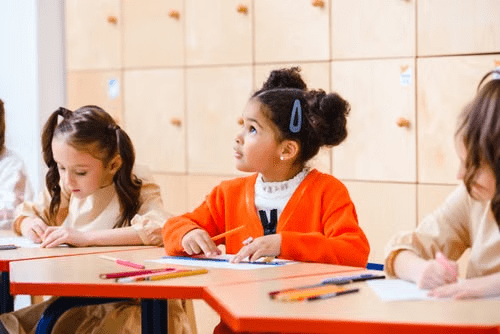
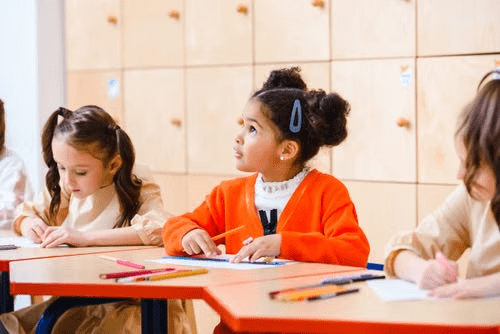
The classroom itself is set up to encourage participation rather than passive listening. Children aren’t all doing the same thing at the same time. They’re choosing activities that match where they are and what they’re ready for.
Teachers spend more time watching, guiding, and supporting than standing at the front of a room delivering lessons.
Children typically experience:
- Hands-on learning materials
- Individual and small-group activities
- Opportunities to work independently
- Practical life exercises
- Calm, organized learning spaces
It’s a quieter kind of teaching, but it tends to produce children who know how to direct themselves, which matters a great deal once they move into more structured school environments.
Why do many families combine child care in Fremont with Montessori learning?
Preschool hours don’t always line up with work hours. Many families need care that covers the full day without uprooting their child from a familiar environment mid-afternoon.
Combining child care with Montessori learning means children stay in one place, with the same teachers and the same routines, from morning through pickup.
Here are some of the practical advantages:
- Fewer daily transitions
- Teachers and peers that you know
- A consistent daily routine
- Learning and socializing all day long
- No need for complicated arrangements on the part of working parents
To kids, it means being in an environment that they recognize. For parents, it removes one of the more stressful parts of the childcare puzzle.
How does Sparkle Montessori support every stage of a child’s learning journey?
At Sparkle Montessori, independence isn’t treated as a destination. It is a process that grows slowly and progressively through experiences in life.
The environment is constructed in such a way as to facilitate children at various stages by offering chances for:
- Making appropriate choices according to one’s age
- Exploring tangible learning objects
- Building practical life skills
- Boosting self-confidence through independent activities
- Learning together with teachers who know when to assist and when to withdraw
As toddlers develop into preschoolers, expectations change with regard to their capabilities. There is a shift in terms of balance among exploration, organization, and guidance, but the philosophy does not change.
Independence develops with everyday experiences
It does not begin with any developmental milestone. It begins with small experiences like making a choice, completing an activity, figuring things out, trying again after it
That’s what Montessori Fremont programs are really built around. Not just academic progress, but the slower, quieter development of confidence, curiosity, and responsibility that happens alongside it.
Those everyday experiences become the foundation. And children who have that foundation tend to walk into new situations, new classrooms, new challenges, new opportunities with a different kind of readiness.
FAQs
1. When can children join a Montessori program?
Montessori programs accommodate children as young as 18 months or 2 years of age.
2. How do Montessori programs foster independence among children?
Children learn to be independent due to practical exercises, hands-on experience, choices made by children based on their age, and performing activities independently.
3. Can toddlers join a Montessori program?
Yes. Montessori programs Fremont are geared towards toddlers and promote the development of independence, coordination, communication, and confidence through regular activities.
4. What is done in a Montessori class?
Children engage in hands-on exercises, practical activities, exploration, and learning activities based on a child’s developmental level.
5. Is it possible to have a combination of Montessori learning and childcare?
Yes. Many parents opt for programs that include both Montessori education and childcare.