Preschool in Fremont That Helps Children Learn, Play, and Thrive
What if the moments that look least like learning are the ones teaching children the most?
In early childhood, some of the biggest lessons happen while children are building towers, arguing over whose turn it is, or figuring out why the paint colors mixed the wrong way.
That’s where a lot of assumptions about preschool start to fall apart. Learning at this age rarely looks like a formal lesson- it happens through experiences that push children to think, talk, and work things out. A good preschool in Fremont creates space for that to happen consistently, helping children build confidence and curiosity alongside skills that actually stick.
Why do parents often see learning and play as two different things?
Most of us grew up associating learning with sitting down and following instructions. So, walking into a preschool classroom where children are moving around freely, digging through art supplies, and building things that keep falling over, it’s easy to wonder where the actual learning is.
Young children don’t develop the way older students do. Their understanding comes through experience, not explanation. Some common assumptions that don’t hold up in practice:
- That play and learning belong in separate parts of the day
- That academic skills need to come before exploration
- That a quieter room means more is getting done
- That play is essentially a break from the real work
Programs that treat play as filler tend to miss what’s actually happening in it.
Can children really learn while they’re playing?
For young children, play is frequently where learning begins.
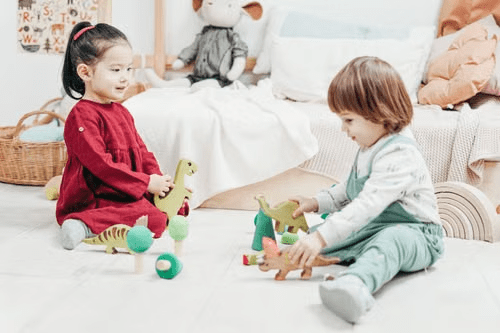
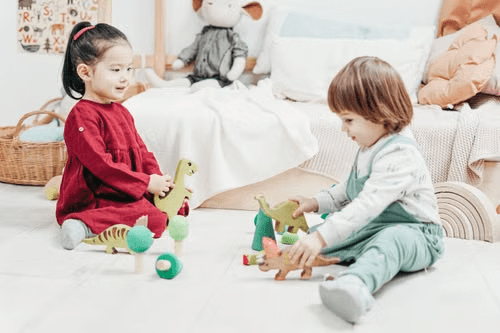
Running a pretend shop, negotiating who gets to be the customer, stacking blocks until the tower tips, working through a puzzle with someone who has a completely different approach- these activities build skills that outlast the activity itself.
Through pretend play
Taking on roles pushes children to communicate, negotiate, and think from a perspective that isn’t their own. Things like playing house, running a pretend restaurant, dressing up, or building imaginary stories develop language and social confidence in ways that don’t feel instructional- which is partly why they work.
Through hands-on exploration
Children hold onto ideas better when they’ve handled them directly. Sorting objects, pouring water, building with blocks, digging through natural materials- these develop observation and logical thinking without requiring a worksheet to do it.
Through group play
Shared activities teach children to take turns, deal with someone else’s idea being chosen over theirs, navigate small disagreements, and work toward something together. None of that is small. Those are skills that keep showing up for years.
What does it really mean for a child to thrive in preschool?
Letters and numbers are part of it, but a fairly small part. Thriving looks more like a child who’s comfortable enough to participate, curious enough to keep asking, and confident enough to try something they might get wrong.
| Area of Growth | How Preschool Supports It |
| Communication | Storytelling, conversations, group discussions |
| Confidence | Trying activities independently |
| Social skills | Sharing, teamwork, building friendships |
| Curiosity | Exploring materials and asking questions |
| Emotional growth | Learning routines, expressing feelings |
These don’t develop in sequence. They tend to show up together, and the signs are usually behavioral- more questions, less hesitation, a child who’s genuinely interested rather than just present.
Why does balance matter more than early academics?
Kindergarten readiness is a real concern for parents, and understandably so. But pressure to front-load academic content in preschool often does the opposite of what’s intended.
Confidence before perfection
Children engage more when mistakes don’t feel like failures. A classroom where trying again is normal produces children who are willing to participate, which matters more at this stage than whether they get the answer right.
Exploration before memorization
Young children retain experiences better than instructions. When they’ve built something, mixed something, or figured something out themselves, the concept sticks because they were part of it rather than just receiving it.
Development happens at different speeds
Some children talk early and take forever to sit still. Others are the opposite. A balanced preschool works with that rather than expecting everyone to be in the same place at the same time.
How does a play-based preschool in Fremont support early development?
Play-based preschool Fremont doesn’t mean the day is unstructured. Purposeful play is designed with specific development in mind- it just doesn’t announce itself as a lesson.
What it tends to build:
- Curiosity, through exploration that doesn’t have a predetermined answer
- Communication, through activities that require children to interact
- Problem-solving, through building, puzzles, and imaginative scenarios
- Creativity, through materials children can use in more than one way
- Independence, through tasks children complete without someone finishing it for them
Children stay engaged longer when the activity feels like theirs. That sustained involvement is where a lot of the actual development happens.
What makes an early learning center in Fremont different from traditional childcare?
The two are often lumped together, but the day-to-day experience can be quite different. An early learning center Fremont typically builds developmental goals into how the day runs, rather than keeping care and learning as separate functions.
| Early Learning Center | Traditional Childcare |
| Learning is built into everyday activities | Focuses primarily on supervision and daily care |
| Guided experiences support early skill development | Free play makes up a larger part of the day |
| Activities target communication, thinking, and independence | Routines center on care and comfort |
| Designed to prepare children for future learning | Designed to meet families’ childcare needs |
The distinction isn’t about one being superior. It’s about what a family is looking for and what the child’s day actually consists of.
Why do some families choose daycare and preschool Fremont programs together?
Preschool hours and work hours don’t naturally align. For most families, that gap needs a practical solution, which is why combined daycare and preschool Fremont programs make sense for a lot of people.
What that typically looks like in practice:
- One consistent routine rather than two separate pickups and drop-offs
- The same teachers and classmates throughout the full day
- Learning that continues after the preschool portion ends
- A familiar environment children don’t have to readjust to mid-afternoon
For children, consistency in the environment matters more than parents sometimes realize. Already knowing the space, the people, and what comes next makes a noticeable difference in how settled a child feels.
How does Sparkle Montessori help children learn, play, and thrive?
At Sparkle Montessori, learning and play aren’t scheduled separately. The environment is set up so they work through each other- exploration leads somewhere, independence is built gradually, and teachers guide rather than direct.
Children are encouraged to work through materials at their own pace, take on tasks without waiting for help, and develop communication through activities that actually require it. The teachers notice what individual children need rather than moving the group along as a unit.
The focus isn’t on hitting academic markers early. It’s on children who are genuinely curious, comfortable with uncertainty, and willing to try things that might not work the first time. Families searching for a preschool in Fremont tend to find that combination more useful in the long run than a narrow focus on school readiness.
Learning, play, and growth work best together
Children don’t divide their day into learning time and play time. They move between exploring, figuring things out, creating, and interacting, and a lot of development happens in that movement without anyone labeling it.
A good preschool in Fremont doesn’t just introduce early concepts. It gives children enough experience with curiosity, problem-solving, and persistence that learning starts to feel like something worth doing, not something that happens to them.
FAQs
1. How much playtime should children have in preschool?
There’s no fixed answer. What matters more is whether the play is purposeful- designed to support development rather than just fill time between structured activities.
2. Can play-based learning prepare children for kindergarten?
Yes, and in some ways more effectively than early academic drilling. The communication, cooperation, and problem-solving skills built through play are exactly what kindergarten assumes children already have.
3. What is the difference between an early learning center and a preschool?
An early learning center usually places more emphasis on structured developmental goals. Preschool is a broader term. In practice, the difference often comes down to what the day actually looks like rather than what the program is called.
4. Is combining daycare and preschool a good option for working families?
For most, yes. A single consistent environment is easier on children than multiple transitions, and it means parents aren’t coordinating between two separate providers.
5. How can I tell if my child is thriving in preschool?
Usually through behavior rather than test scores- more questions, more willingness to try unfamiliar things, less resistance in the morning, and a child who has something to say about what happened during the day.